

The AI family: from AI to LLMs Watch
People often mix up the words AI, machine learning, deep learning, generative AI and large language models. The easiest way to remember them is as circles inside circles.
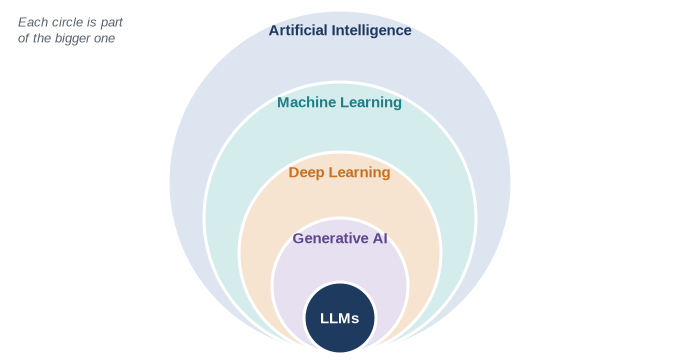
- Artificial Intelligence - any technique that makes machines act intelligently, including hand-written rules.
- Machine Learning (ML) - AI that learns from data instead of fixed rules.
- Deep Learning (DL) - ML that uses neural networks with many layers.
- Generative AI - deep learning models that create new content: text, images, audio, video, code.
- Large Language Models (LLMs) - generative models trained on huge amounts of text to understand and write language.
Types of AI by capability Watch
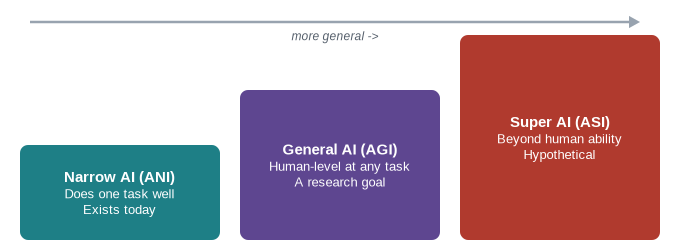
Narrow AI (ANI), also called weak AI, is designed for a specific job: recognising faces, recommending songs, translating text or playing chess. Every AI system in use today is narrow AI - even very capable chat assistants have clear limits.
General AI (AGI) would be able to learn and perform almost any intellectual task a human can, and transfer knowledge between very different areas. Building AGI is a stated goal of several AI companies, but experts disagree on how close we are and how to define it.
Super AI (ASI) is a hypothetical AI that would surpass human intelligence in every area. It is discussed mainly in research about long-term AI safety.
Types of AI by functionality Watch
| Type | What it means | Example |
|---|---|---|
| Reactive machines | React to the present situation; no memory of the past. | Deep Blue chess computer |
| Limited memory | Use recent data or past examples to decide. | Self-driving features, chat assistants |
| Theory of mind | Would understand emotions, beliefs and intentions. | Research stage only |
| Self-aware AI | Would have its own consciousness. | Does not exist |
Rule-based AI versus learning AI Watch
Early AI was mostly symbolic or rule-based: experts wrote thousands of IF-THEN rules ("IF the patient has a fever AND a rash THEN consider measles"). These expert systems were transparent but brittle - they broke whenever a situation was not covered by a rule. Modern AI is mostly statistical: it learns from data and copes better with messy real-world input, but its reasoning is harder to inspect.
Discriminative versus generative AI Watch
| Discriminative AI | Generative AI | |
|---|---|---|
| Job | Classifies or predicts | Creates new content |
| Question it answers | "Is this email spam?" | "Write me a polite email." |
| Output | A label, number or score | Text, image, audio, video, code |
| Examples | Fraud detection, face recognition | Chat assistants, image generators |
Chapter summary
- AI contains machine learning, which contains deep learning, which powers generative AI and LLMs.
- All real AI today is narrow AI; AGI is a research goal and ASI is hypothetical.
- Discriminative AI classifies and predicts; generative AI creates.
- Rule-based systems are transparent but brittle; learning systems are flexible but harder to explain.